Bridge crossing
Safer, better river crossings and bridge resilience

We asked our community to brainstorm transport ideas to respond to the three transport problem statements from December 2025. These ideas were used to inform an endorsed draft long list of transport ideas.
Safer, better river crossings and bridge resilience
Local buses and shuttles for easier daily travel
Keep heavy freight on suitable routes
Safer active travel routes, paths and crossings
Better flow and management across the wider network
Growth aligned with transport and local services
Smart parking supply and access management
Safer crossings, lighting, and everyday travel
Smoother traffic flow on key roads and approaches
Safer, more efficient intersections at key pressure points
| Themes | Options |
| Environment |
|
| Land use and spatial planning |
|
| Walking, cycling and micromobility |
|
| Themes | Options |
| CBD / Town centre | Restrict delivery hours in the CBD |
| Freight management |
|
| Manage demand |
|
| Walking, cycling and micromobility |
|
| Themes | Options |
| CBD / Town centre |
|
| Corridor improvements |
|
| Intersection improvements |
|
| Network management |
|
| Parking management |
|
| Public transport services |
|
| Safety improvements |
|
| Walking, cycling and micromobility |
|
| Themes | Options |
| Bridge crossing |
|
| Intersection improvements |
|
The assessment of the long list will be presented to the Strategic Planning and Policy Committee.
Every time we buy something, we’re engaging with freight. It’s essential to our economy - but how do we deal with trucks rumbling down our streets?
Last year, one of the key themes that came out of feedback was the issue of freight pressure. Now, we want to hear your solutions!
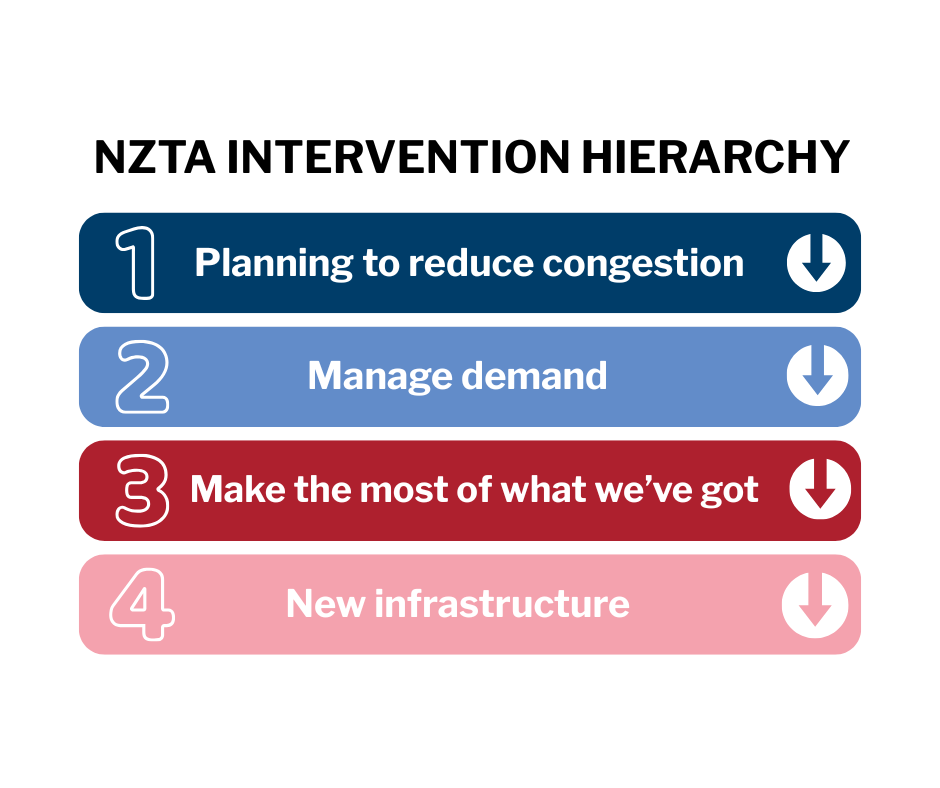
As we answer the feedback questions, we can set ourselves up for success by following NZ Transport Agency guidelines that will help us build a business case to seek funding. Follow the NZTA intervention hierarchy.
This guides how we think about transport planning, starting with the lower cost options:
1. Planning to help reduce congestion
First, we look at integrated planning – making sure transport is part of how we plan land use. So, if new homes are being built, we think about providing bus stops near where we live, and footpaths to connect to places people want to go.
It also means having shops and services close to where people live, so more trips can be done without relying on cars. Integrated planning will help ease congestion, with fewer cars on the road and more ways to get around.
What ideas do you have for integrated planning?
2. Manage demand
Next, we look at managing demand – helping people travel at different times, in different ways - or not needing to travel at all.
Businesses can encourage carpooling, have flexible work hours to avoid busy times on the road, and install bike parking and showers so staff have choices about how they get to work.
We can also think about how we manage parking in town – to free up spaces and keep things moving.
How can we manage demand as Cambridge grows?
3. Make the most of what we’ve got
Third, we think about how we make the most of the transport system we already have. This could mean connecting our cycleways – like linking Leamington to Cambridge High School, so students can bike safely across town.
We might think about how we keep traffic moving, especially over Victoria Bridge.
How can we make the most of the transport system we’ve got?
4. New infrastructure
Finally, we look at new infrastructure - the projects that solve problems we can’t fix with what we already have. These can be costly and take longer to build – so they come last in the hierarchy.
In feedback during stage one, the community was clear: you want another bridge for Cambridge. We’ve heard you. By the end of this year, we’ll have a 30-year transport plan and Elected Members will decide on a proposed location of a bridge corridor.
This will be a general area where a new bridge could go, so investigations can start. No decisions have been made yet - and the community will be involved every step of the way.
Like any big infrastructure project, a new bridge will be the longest-term and most expensive part of the plan. We will need to do a number of other things in the meantime to keep people and freight moving.
What ideas do you have for new infrastructure?
To build a case for funding, we must comply with legislation and government policy. This means some things are not negotiable, but we value your input on the things that you can help shape.
What you can have a say on:
What’s set in place:
Like any brainstorm, not all ideas can be implemented because we need to consider NZ Transport Agency requirements, what’s doable, what’s affordable and what will work best to solve transport problems for Cambridge.
All your feedback will be heard and analysed, alongside ideas that were presented in stage one and during the previous Cambridge Connections project in 2023.
The key themes that emerge will inform the technical work of developing a ‘long list’ of transport options. Elected Members will make decisions about how we assess what goes into the long list, and the final long list of options.
Then, stage two of the project will be complete.
Next, we’ll work on turning that long list into a short list of options for Cambridge transport – and we’ll come back to the community for your feedback on that as well.

Have questions or want to learn more about a project, contact us below:
| Phone | 0800 924 723 |
|---|---|
| info@waipadc.govt.nz | |
| Website | www.waipadc.govt.nz/ |
Get notifications on what's happening in your town.
| Website | www.waipadc.govt.nz/antenno |
|---|